

Meet The Selectors: Jonny Trunk
In Meet The Selectors, we highlight the selectors, DJs and music experts that have presented Listening Sessions at the Devon Turnbull Listening Room in 180 Studios.
Across decades of digging, Jonny Trunk brought cult soundtracks, library LPs, and oddities back into circulation, guided by a taste that has often gone against the grain. In light of his ongoing residency at the Listening Room in 180 Studios, VF's Kelly Doherty spoke with Trunk to examine the curiosity, humour, and sincere passion that defines a career spent championing the unheard.
For over three decades, Jonny Trunk has been building a world out of the forgotten. As a collector, broadcaster, and founder of Trunk Records, he has released scores of beautiful, overlooked records from total obscurity including the soundtracks to The Wicker Man and Dawn of The Dead, early compositions from the legendary Delia Derbyshire and much more.
What began as one man's curiosity grew into a counter-history and a reminder that some of the most imaginative, strange, affecting music of the last century lived far outside the spotlight. Put simply, Jonny Trunk offers an alternative to ongoing waves of algorithm-driven, attention economy baiting music consumption.

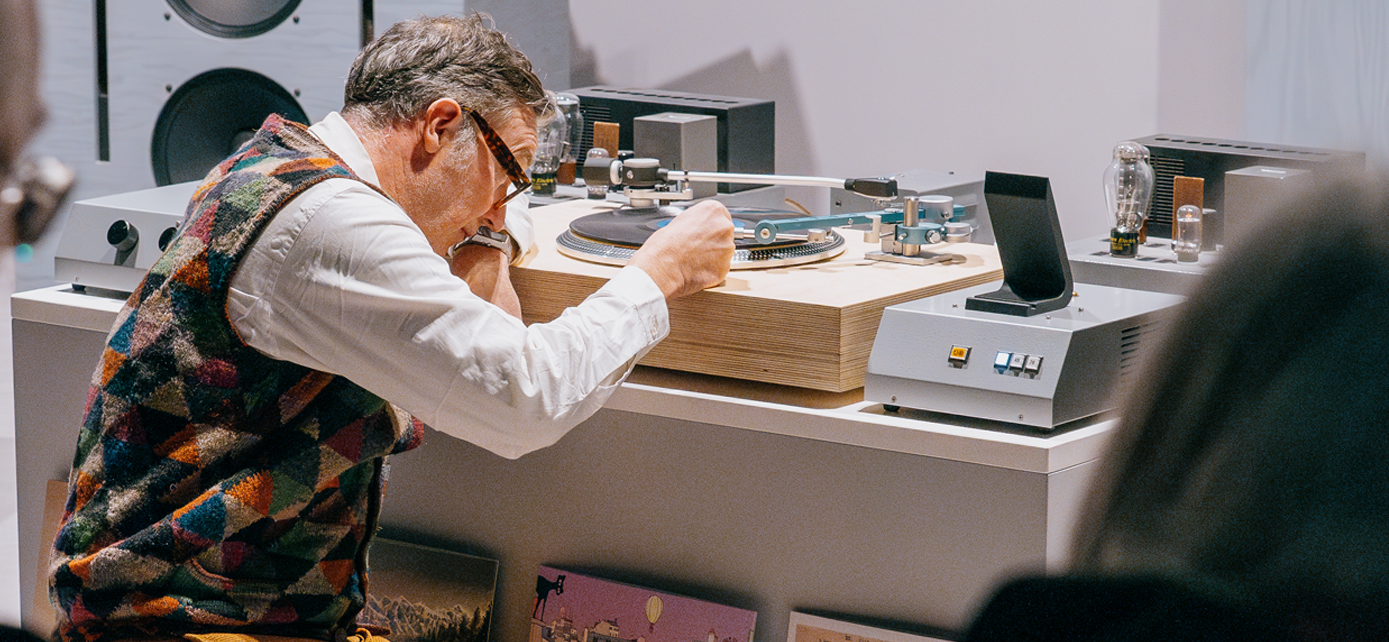
At the moment, he regularly brings that spirit to 180 Studios as a resident selector in Devon Turnbull’s Listening Room, a space that rewards open‑eared, open‑hearted listening. Trunk’s presence here makes perfect sense. His life’s work has always been about paying close attention to the records that no one else has.
Charming and dryly funny, Trunk has a storyteller’s instinct that draws you in. With his twinkling enthusiasm and encyclopaedic curiosity, he combines the knowledgeable air of an old‑school record shop owner with a warmth that makes his passion feel contagious. “I remember hearing an instrumental version of Burt Bacharach’s Do You Know the Way to San Jose at my granny’s house,” he says of his earliest musical excavation. “It tickled my insides. I went, ‘What is going on here?’”
Instinctively, his tastes sat at odds with the dominant sounds of the ’80s. “My ears were slightly different to everybody else’s,” he explains. “People I knew were into rock and pop and Genesis. I tried all that and just didn’t understand it.” Instead, he found himself scouring London’s jumble sales and record shops, places he describes as “really grumpy, not very progressive and with a set view of the musical world.”
The racks rarely offered what he was looking for. “There was no internet, books or price guide,” Trunk recalls. “Record stores knew what Queen was worth, but a Brazilian record? No idea. They’d stick it in a box on the floor for 50p. That’s where I found Moog records, jazz and experimental sounds. It blew my head off.”

Television provided him with another treasure trove. The music from Starsky & Hutch or The Six Million Dollar Man resonated more than anything on the radio. He preferred the instrumental, cinematic approach: expressive without sentimentality. “No one was sick and moaning or singing about something that was going wrong,” he laughs.
Around this time, a coworker at McDonald’s introduced him to Cal Tjader and Hammond jazz. “These were records with really great covers. Abstract art, interesting musicians with cool glasses and clothes,” he says.
His discoveries soon shifted from private hoarding to communal sharing. He made mixtapes for friends and commandeered the speakers at his pizza‑restaurant job. “I’d get an enormous amount of pleasure out of sharing it. Otherwise how would anyone find out about it?”
Eventually, that impulse became the foundation for his record label. When Trunk Records launched in 1995, it began as a self‑serving project, an excuse to press music he couldn’t find elsewhere. It quickly grew into an informal archive of lost British sound. He started reissuing film and TV scores, library LPs, and early electronics long buried in attics and bargain bins. The label’s early catalogue revived interest in Basil Kirchin, John Baker, and Tristram Cary. It also helped spark a broader interest in library music, years before streaming and late-night YouTube rabbit holes.

Around the same time, he launched The OST Show on Resonance FM. His book The Music Library expanded the project visually, cataloguing hundreds of album sleeves and offering a history of the design language that accompanied this hidden musical world.
For Trunk, the search is still the reward. “You have to make cheap mistakes to find something incredible,” he says. He describes running the label as “detective work,” often spending months tracking down the rights to the music he reissues. “Finding people is the fun bit. Sometimes it takes years.”
One search nearly collapsed when he tried to reissue Hear, O Israel, a 1960s Jewish prayer service featuring Herbie Hancock. A New York synagogue, which had approved the deal months earlier, suddenly pulled out after discovering vintage topless photos elsewhere on Trunk’s website. “They’d known who I was for two years,” he says. “I nearly lost it all because of a ’70s picture of a nude woman cooking,” he laughs.
Trunk has mixed feelings about the current vinyl‑reissue wave and its interpretation of rarity as quality. “It’s brilliant that people can find things now,” he says. “The problem is that the rarest doesn’t mean the best. You get stuff issued that’s just not very good or it’s got one track on it. What’s the point of having it?”.
The Listening Room brings Trunk’s inquisitive approach to a new audience. A friend recommended him, convinced his niche collection would thrive on Turnbull’s intimate custom hi‑fi system. He sent over a few ideas and was quickly invited to join the residency. “It’s my kind of DJing,” he says. “I like music that doesn’t necessarily make people dance.”
.jpg)
He plays only original pressings, taken from his personal collection. “They sound phenomenal in that room, clear, warm, so defined, so real.” Between tracks, he shares anecdotes and hidden histories. “It’s just like sharing a cassette in the car,” he says. “It gives them the feeling I got when I first heard it and that’s what it’s all about.”
Each session begins with a loose theme. “It takes about five minutes to think up,” he says. Previous sets have explored underwater music (“I mean, when are you ever going to hear that?”), exploitation soundtracks and Halloween sounds. His latest focused on Ennio Morricone, moving from Malamondo to Cinema Paradiso with “a few deep cuts” in between. While the themes arrive instantly, the preparation takes hours as he pulls from his collection, defines the scope of his sessions and decides “what will be fun” for his audience to hear.
Trunk draws a line between the Listening Room and listening bars elsewhere. “They’re not listening bars,” he says. “They’re just bars. Someone always asks you to turn it down. The Listening Room is fantastic. There are always interesting people sitting down, closing their eyes, really going for it. Long may it run.”
He continues to search for the unheard: for the rights to records that may never reappear, and for audiences to share them with. He’s developing a string of Listening Room sessions at 180 Studios, including a John Barry set, a KPM night, a post‑punk selection, and a Christmas special. “I’ve got some brilliantly mad Christmas records,” he says, eyes lighting up. “It’s my favourite genre.”
.jpg)
An appeal of obscure music lies in the thrill of discovery. Finding something surprising hidden in overlooked grooves is akin to being let in on a secret. Trunk has dedicated his career to amplifying that secret until its reverberations have dispersed widely enough for it to be an accepted truth.
Whether he’s pressing a lost soundtrack, telling stories in Turnbull’s room, or hunting down a long unknown composer, Trunk is always chasing that first Bacharach feeling and the surprise of something unexpected tickling his insides.
Learn more about the events at Devon Turnbull's Listening Room in 180 Studios here.