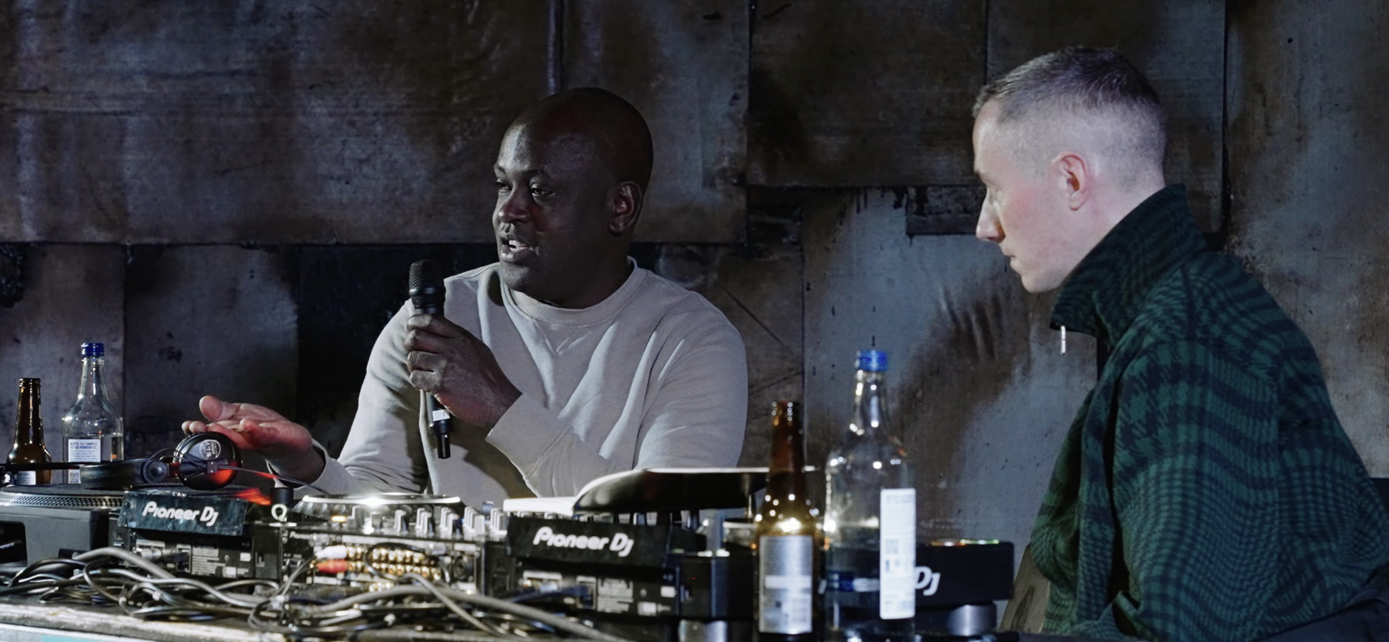
In Conversation: Benji B and Plastic People's Ade Fakile
A rare hour long chat about London institution Plastic People.
"You’re going to hear a lot about Plastic People tonight. Apart from my home, it’s the space where I’ve spent the most hours of my life. And it’s the club I spent the most time in – that’s true for many of us here. It was Ade’s club.
It’s not around anymore, but its influence was so strong that entire genres were born there. Dubstep, for example: FWD, shout to Sarah Lockhart, was instrumental in incubating the genre that became dubstep. Alongside DMZ, it was probably the most important night.
The same goes for Co‑Op, which Ade gave a home to and which went on to birth broken beat. I could go on, but maybe we should start at the beginning. What was Plastic People? Where was it? What did it look like, what did it sound like, and what was the intention?"
At The Vinyl Factory: Reverb exhibition in 180 Studios last year, Benji B and Ade Fakile came together on the Theaster Gates' stage for a special night of live conversation reflecting on the legacy of Plastic People, the Shoreditch club founded by Fakile that played a defining role in UK club culture throughout the 2000s.

Held in front of a live audience, the talk sees broadcaster, DJ and longtime Plastic People regular Benji B lead a wide-ranging discussion with Fakile about the origins of the club, its approach to sound, and the conditions that allowed Plastic People to become a testing ground for new music and ideas.
Plastic People began without a formal plan. Fakile describes it as an accidental project, shaped by limited resources and practical decisions rather than a manifesto. Early iterations of the club placed the DJ in the centre of the room, using improvised structures and minimal lighting to prioritise the relationship between sound system, DJ and dancefloor.
Fakile traced his sensitivity to acoustics back to growing up in Ibadan, Nigeria, where his father worked with public sound systems. That experience informed Plastic People’s emphasis on acoustic treatment, controlled volume, spatial listening and all of the elements that would later distinguish the club from many of its contemporaries.

Benji B and Fakile also discuss Balance, Fakile’s Saturday night residency, which became known for its open musical approach and its influence on a generation of DJs. Balance rejected strict genre boundaries, encouraging selection based on musical compatibility rather than tempo or trend. Fakile’s use of EMT broadcast turntables is discussed as part of a wider commitment to sound quality and record playback.
The pair revisit key moments in Plastic People’s history, including New Year’s Eve 2001, when Fakile booked Pharoah Sanders to play at midnight. The event, which also featured appearances from Madlib, Theo Parrish, Basic Channel and the lare Andy Weatherall, proved financially difficult at the time but has since become a widely referenced moment in the club’s history and one of the craziest line-ups London has seen.
Watch the full conversation above or on YouTube.
More from The Vinyl Factory
The Listening Room Episode One: The Lost Sounds of Pakistani Cinema with Haseeb Iqbal
Haseeb Iqbal on Spiritual Jazz
Meet The Selectors with Coco María
Isaiah Collier & Tim Regis - Live in The Listening Room on vinyl